5.3.1 Does your university as a body systematically measure/track women’s application rate, acceptance/entry rate and study completion rate at the university?

The Islamic University of Lebanon (IUL) is committed to fostering gender equity across all aspects of academic life. Currently, the university systematically measures and tracks key indicators related to women’s academic participation, including application rates, acceptance/entry rates, and study completion rates.

These metrics are gathered as part of IUL’s broader commitment to creating a diverse and inclusive academic environment. By analyzing this data, the university identifies trends and potential barriers to ensure equitable access and opportunities for female students. This monitoring also supports evidence-based initiatives aimed at encouraging women’s academic achievement and professional success.

SDG 5.3.1: IUL has systematically measure/track women’s application rate, acceptance/entry rate and study completion rate at the university

Measurement of Students regarding their Gender:

School Enrolment

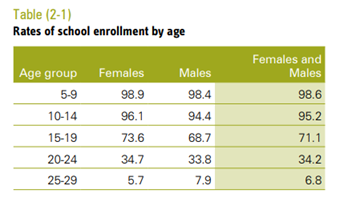
The school enrollment rate at the elementary level in Lebanon, for both males and females, is very high. The National Survey of Household Living Conditions 2004 – 2005 reveals results touching 98% and 95% respectively for age groups (5-9) and (10-14), which decline to approximately 70% for the age group (15-19). It is worth noting that school enrollment rates for females and males are very similar in Lebanon at all educational levels, with a slight increase in female enrollment at certain levels. See table (2-1)

2. School enrolment and age-grade delay at the elementary level1

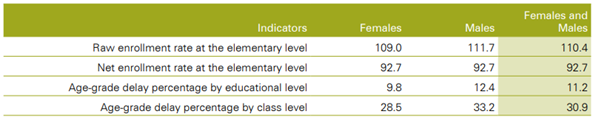
 According to the National Survey, the raw enrollment rate for male students at the elementary level is 111.7%, (i.e. the total number of students enrolled at the elementary level, of all ages, compared to the total number of students aged 6 to 11). However, the net enrollment rate of male students is 92.7%, (i.e. the total number of students aged 6 to 11 years enrolled at the elementary level, compared to the total number of students aged 6 to 11). The difference between these two averages results from agegrade delay by male students.

The percentage of male students’ age-grade delay at the elementary level as a whole is 12.4%, (which is equivalent to the percentage of students above 12 years of age who are registered in elementary education, compared to the total number of students at the elementary level). Whereas the percentages of male student’s age-grade delay at the class level is 33.2%, (i.e., the percentage of those who are older than the supposed age of each relevant elementary level class compared to the total number of students at the elementary level).

The female enrolment rates at the elementary level do not differ greatly from those of the male students, as the raw female enrolment rate at the elementary level is 109.0%, and the net enrolment rate 92.7%. However, the age-grade delay percentages of female students are lower than those of male students, with the percentage of female students’ elementary level age-grade delay as a whole is 9.8%, and the class level age-grade delay percentage is 28.5%. See table (2-3)

Table (2-3) Rates of school enrollment and age-grade delay at the elementary level, by sex

  1. School enrolment and age-grade delay at the intermediate level2

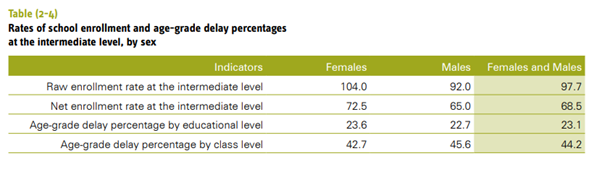
At the intermediate level, the raw enrolment rate for male students aged 12 to 14 is 92.0%, compared to 104.0% for females of the same ages. The net enrolment rate for male students aged 12 to 14 is 65.0%, as opposed to 72.5% for female students.

  • Raw enrolment rate for intermediate level students = (total number of registered students in the intermediate level of all ages ÷ total number of students aged 12 to 14) × 100
  • Net enrolment rate for intermediate level students = (total number of registered students in the intermediate level aged 12 to 14 ÷ total number of students aged 12 to 14) × 100

Age-grade delay percentages at the intermediate level are 22.7% for males and 23.6% for females, whereas the class age-grade delay percentages at the intermediate level are 45.6% for males and 42.7% for females. Thus, at the intermediate level, there are higher enrollment rates for female students, but a relative proximity between the sexes in age-grade delay per educational level. See table (2-4)

  • Age-grade delay percentage at the intermediate level as a whole = (total number of students aged 15 years and above who are registered in the intermediate level ÷ total number of students at the intermediate level) × 100
  • Age-grade delay percentage by class at the intermediate level = (total number of students registered in intermediate level classes who are above the supposed age of each relevant intermediate class ÷ total number of students at the intermediate level) × 100
  1. School enrolment and age-grade delay at the secondary level

Enrolment rates begin to differ drastically between males and females at the secondary level (typically aged 15 to 17), where the raw enrollment rates for male and female students is 58.8% and 65.7% respectively, and the net enrollment rates are 39.2% for male and 45.6% for female students.

  • Raw enrollment rate for secondary level students = (total number of registered students in the secondary level of all ages ÷ total number of students aged 15 to 17) × 100
  • Net enrollment rate for secondary level students = (total number of registered students in the secondary level aged 15 to 17 ÷ total number of students aged 15 to 17) × 100 Chapter II Educational status 44 The age-grade delay percentages between the sexes also differ for the secondary level as a whole, with 28% for males and 25.1% for females. The age-grade delay percentage of the secondary level by class is 51.1% for males and 47.5% for females.

See table (2-5)

  • Age-grade delay percentage for the secondary level as a whole = (total number of students aged 18 and above who are registered in the secondary level ÷ total number of students at the secondary level) × 100 • Age-grade delay percentage by class at the secondary level = (total number of students registered in the secondary level classes who are above the supposed age of each relevant secondary class ÷ total number of students at the secondary level) × 100

IUL Registration Requirements are equal of same conditions for all participants either males or females:

STUDENT AFFAIRS DEPARTMENT

The Student Affairs Department (SAD) is mostly in charge of registrations, incoming and outgoing mobility of the students, scholarships and social subsidies. More precisely, this department is in charge of:

  • supervising the smooth functioning of the departments under its supervision;
  • registering the students, organizing their files and registering it;
  • proposing modifications concerning the registration procedures;
  • supervising the examinations and entry exams;
  • provide student IDs;
  • provide certificates;
  • supervise foreign student files and offer help concerning the university and extra-university adaptation.

REGISTRATION REQUIREMENTS

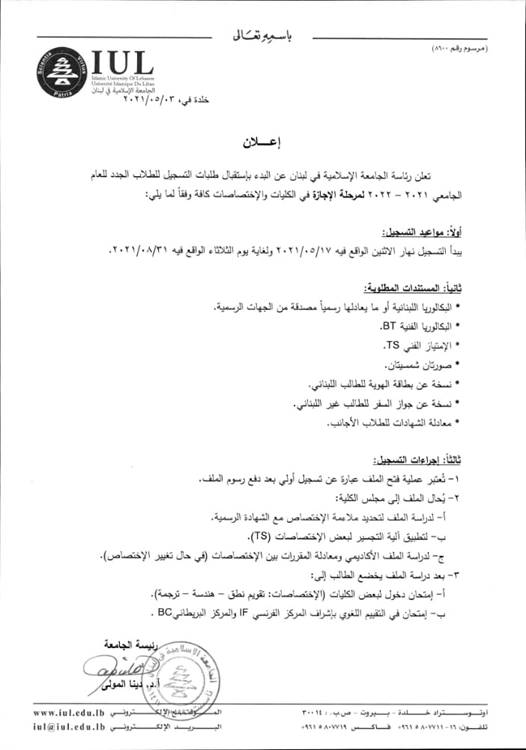
Bachelor’s Program

  • Officially certified copy of Lebanese Baccalaureate Certificate or its equivalent
  • Technical Baccalaureate Diploma – BT
  • Technical Superior Diploma – TS
  • Two passport photos
  • Copy of Identity Card (ID)
  • Copy of foreign student passports
  • Equivalence certificates for foreign students

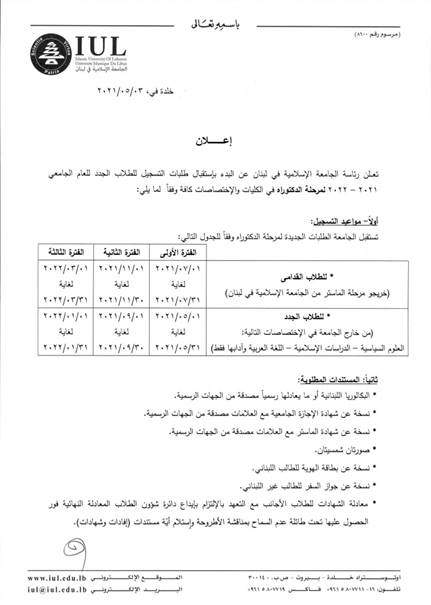
Master’s Program

  • Officially certified copy of Lebanese Baccalaureate Certificate or its equivalent
  • Officially certified copy of Bachelor’s Degree with Transcript of Records
  • Two passport photos
  • Copy of Identity Card (ID)
  • Copy of passport for foreign students
  • Equivalence certificates for foreign students